



VigilHub: protecting warehouse racking, from blank page to the pallet pushing back
How Fancy Pixel turned Cognitiva's idea into VigilHub: custom electronics, a 3D-printed bumper and a multitenant web app to monitor impacts and deformation of pallet support beams.
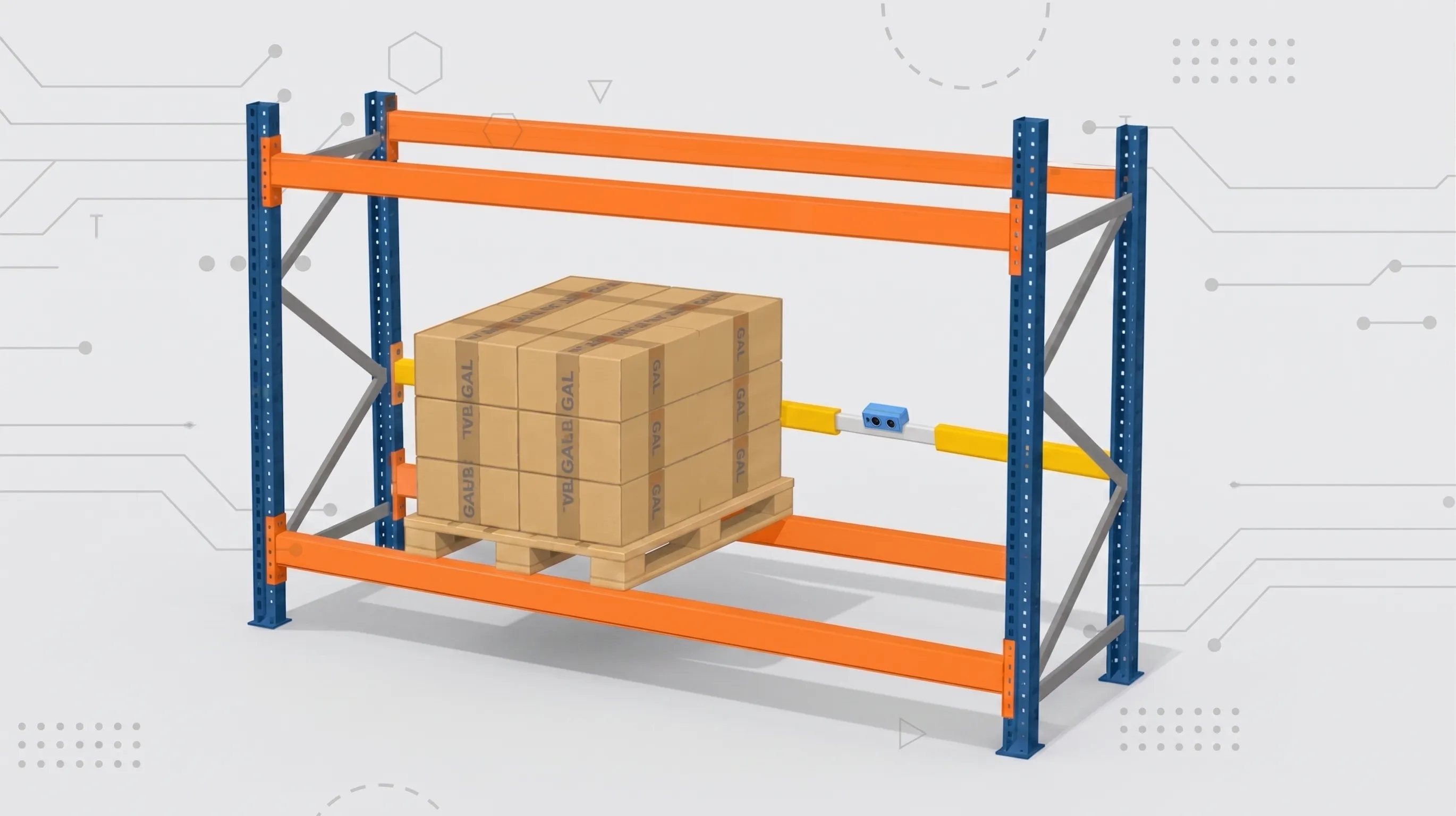
Three months
Three months. That is how long it took to go from the idea Cognitiva put on the table to the system we showed at Ambiente Lavoro.
It is called VigilHub, it is a Cognitiva patent, and it protects the pallet support beams of warehouse racking on three fronts. While the forklift sets down the pallet, the system visually guides the operator to the right spot. When the impact happens anyway, you know. When a beam starts to give way, you know before it becomes a problem.
Cognitiva is an innovative startup based in Reggio Emilia that develops patents and integrated engineering solutions for industrial logistics. They arrived with a clear idea and a patent to bring to life; we took care of everything else, taking them from the rough concept to the finished, physical solution. This article is about how.
The problem: the impact you don’t see
In a warehouse, racking is a piece of safety infrastructure, not furniture. Pallet support beams hold tonnes several metres off the ground, and their everyday enemy is a mundane one: the forklift. A pallet set down badly, a manoeuvre slightly too fast, an impact that seems like nothing at the time.
The catch is that these events are mostly invisible. An impact leaves a tiny deformation, the operator moves on, and the beam accumulates damage until a deformation that could have been caught in time becomes a structural risk. The UNI standards on racking maintenance set precise tolerances for beam deformation, precisely because past a certain threshold the component has to be unloaded and replaced. The problem is not knowing what the threshold is: it is noticing, in the bustle of a warehouse, that a beam has crossed it.
VigilHub exists to make all of this visible. Not afterwards, during the periodic inspection, but at the moment it happens.
What we built
One thing to be clear about upfront: what we brought to the fair is a prototype version of the final project, built specifically for Ambiente Lavoro and to validate the technology. It is there to prove the approach works, not to be installed in a warehouse tomorrow morning. With that in mind, starting from Cognitiva’s idea, at Fancy Pixel we worked across the whole stack, from the electronics to the cloud.
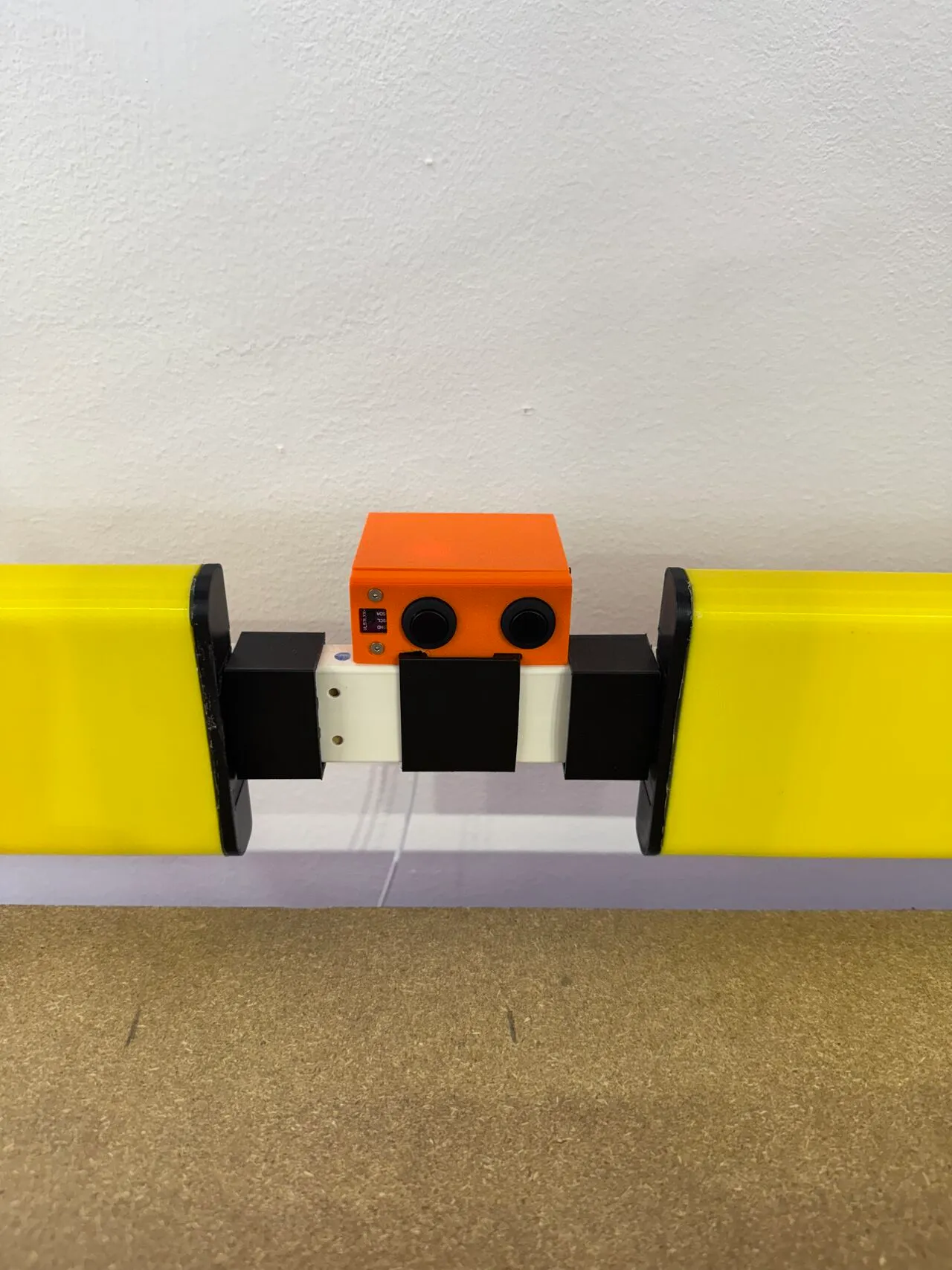
The orange box: a 3D-printed enclosure housing the circuit board, clamped between two sections of bumper.
- The circuit board. At the heart of the system is a custom board, designed by us, that carries on board all the sensors needed to measure the three quantities that matter: distance (and therefore the position of the pallet as it is being set down), impact and beam deformation. Manufacturing of the board is handled by our partner MB Elettronica.
- The enclosures and the small parts. The orange boxes you can see clamped to the beams were designed and 3D-printed by us. They house the electronics and hold them in place, exposed to the bare minimum but in the right spot to read what is needed. Alongside them we designed and printed all the small parts needed to assemble the system onto the pallet support beam: brackets, clips, spacers. Everything it takes to hold the pieces together.
- The yellow bumper. Also 3D-printed, but in flexible TPU and with a hollow cross-section. It is the bumper that takes the pallet’s hit in the beam’s place.
- The web app. A multitenant management platform, Ruby on Rails on the backend and React on the frontend, from which customers govern devices, events, thresholds and reports.
- The gateway. We integrated Indaconn Edge, our IIoT platform, as a secure-by-design bridge between the warehouse and the cloud.
None of these pieces is interesting on its own. It becomes interesting when they work together: a few moments after the impact, an operator on the other side of the warehouse sees the status of that VigilHub change on a screen.
The bumper that absorbs
The yellow bumper is worth dwelling on, because it is the piece that best captures the kind of problem VigilHub has to solve.
A bumper has to do two seemingly opposite things. It has to protect, so it needs to be present and sturdy. But it also has to cushion: if it were rigid, it would transmit the impact straight to the beam, that is, to the very element we want to safeguard. The answer was to print it in TPU, a flexible material, with a hollow cross-section that gives the bumper room to deform and spring back. The pallet takes the hit against the bumper, the bumper absorbs part of the energy, and the sensors read what is left. Protection and measurement in the same gesture.
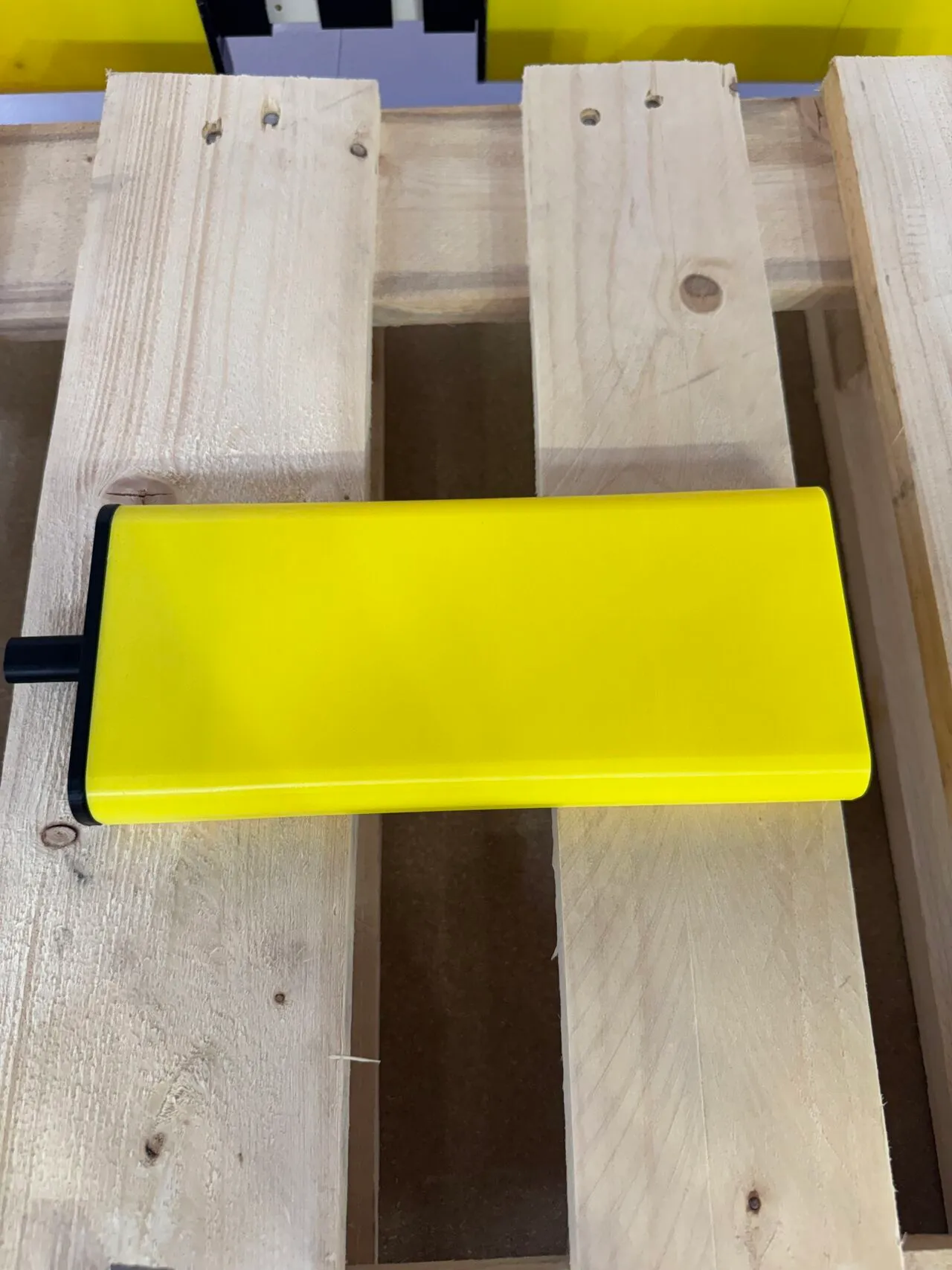
A bumper module printed in TPU: the hollow cross-section is what lets it absorb the impact instead of passing it on to the beam.
The web app: the warehouse at a glance
The beta of the web app is designed to give the customer the overall picture of their storage, and then let them drill down into a single VigilHub.
The idea is to move through levels:
- a top-down view of the facility floor plan, with the ability to define the different areas;
- inside each area, a map of the racking;
- clicking on a rack opens a front view that identifies the load units with their respective VigilHubs, showing the presence and position of the pallet, the status of the pallet support beam against the standard tolerances, and the beam’s registry data;
- the detail of a single VigilHub, to read the raw data;
- a notification system that alerts you when the status of a VigilHub changes.
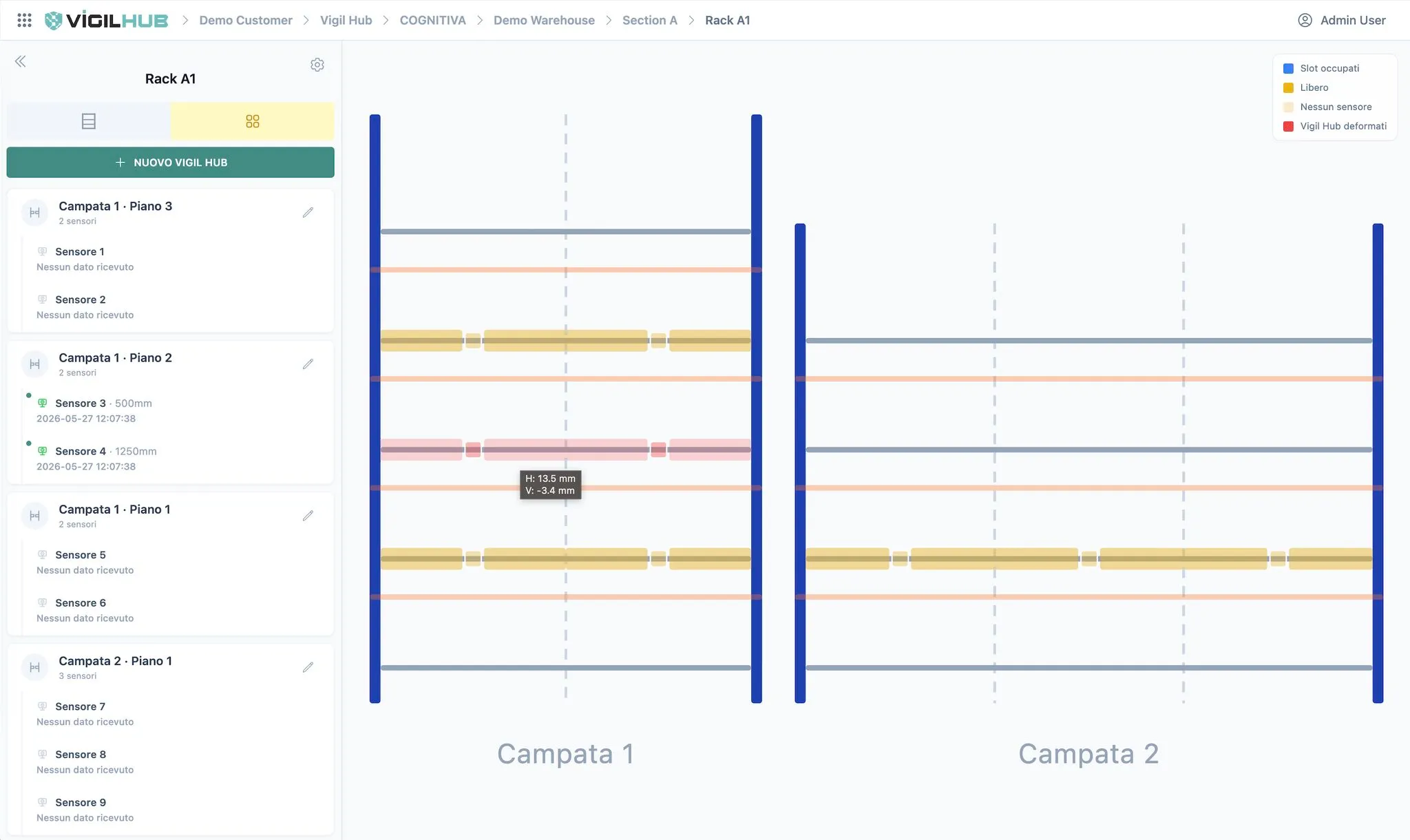
The front view of a rack in the web app: occupied pallet slots in blue, free ones in yellow, and in red the VigilHubs flagging a beam deformed past its tolerance.
The platform is multitenant from the ground up: each customer sees only their own warehouse, but there is a single underlying infrastructure. It is a choice you pay for at design time and that pays back with every new customer added without touching the code.
The demo, piece by piece
The demo we brought to the fair, with the pallet pushing against the beam and the system reacting in real time, we designed and built in house, piece by piece.
It is a scale rack with VigilHub fitted and a few pallets to simulate how the system works. You push a pallet against the beam, the way a forklift making a bad manoeuvre would, the beam deforms just enough, and the system detects, measures and reports. On the screen the pallet slot shows as occupied: the sensor measures the pallet’s distance from the beam, so as well as guiding the driver to the right position it also flags the presence of the load to the system’s users. And if the deformation crosses the threshold, you watch it change colour.
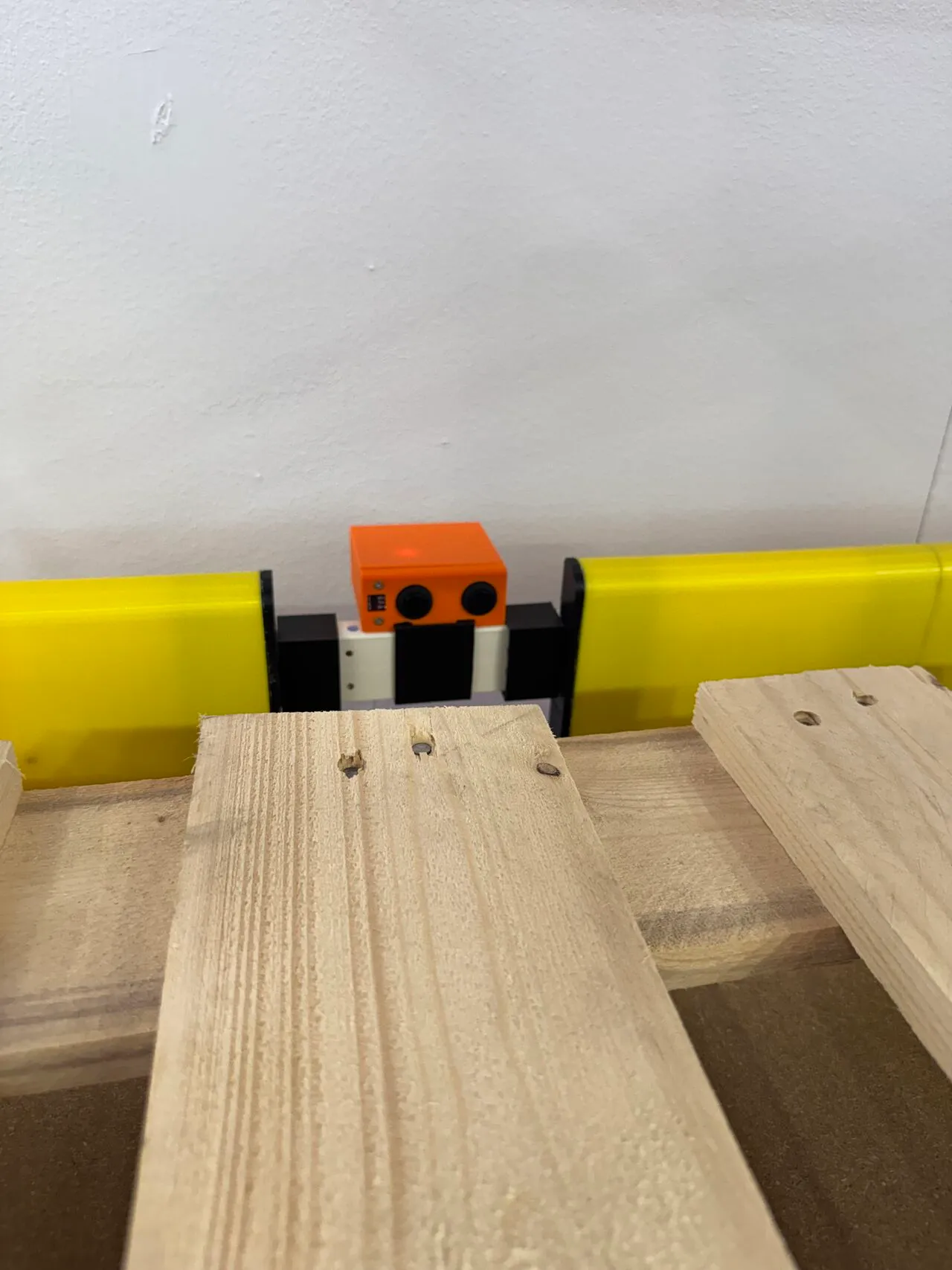
The demo setup: you push the pallet towards the beam, the way a forklift would when setting down a load.
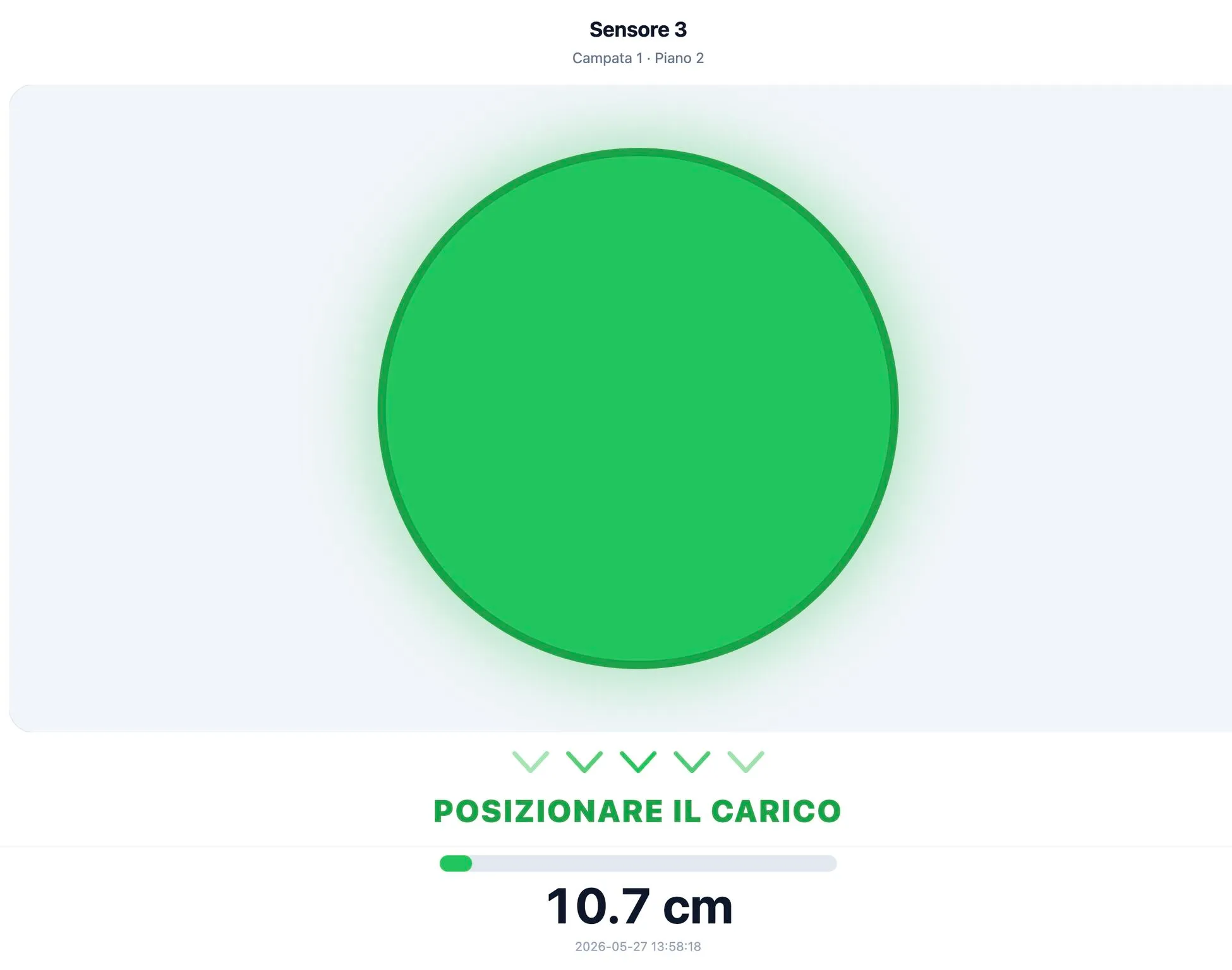
The visual guidance for the driver: the sensor measures the distance in real time and shows when the load is in the right position.
Projects like this are the ones we enjoy most at Fancy Pixel. As a founder, they are also the kind of work I most like to follow: they let us get our hands on everything in a single project, electronics, printed plastic, code and cloud, and take the customer from the idea to a result you can touch with your own hands. This is the kind of journey where we do our best work, and precisely why we keep these skills sharp.
What we take away
VigilHub today is a prototype: it shows off the system’s features well, and that was the goal for the fair. What remains open are the steps that separate a convincing prototype from a product installed in a real warehouse, where the beams number in the dozens, the forklift is not to scale and false positives are paid for in trust.
What we take away from these three months is not so much any single technical choice, but the rhythm you get when the customer arrives with a clear idea and gives you room to execute. Cognitiva gave us their trust and their space; the rest was the team’s work. Three months from blank page to the pallet pushing back: when the constraints are clear and the trust is there, this is what comes out.