


A PoC built with AI costs about as much as dinner. The bill comes at the end of the night
What it really costs to build an AI assistant on your documentation: the numbers item by item, from tokens to review hours, with the public price lists in hand.
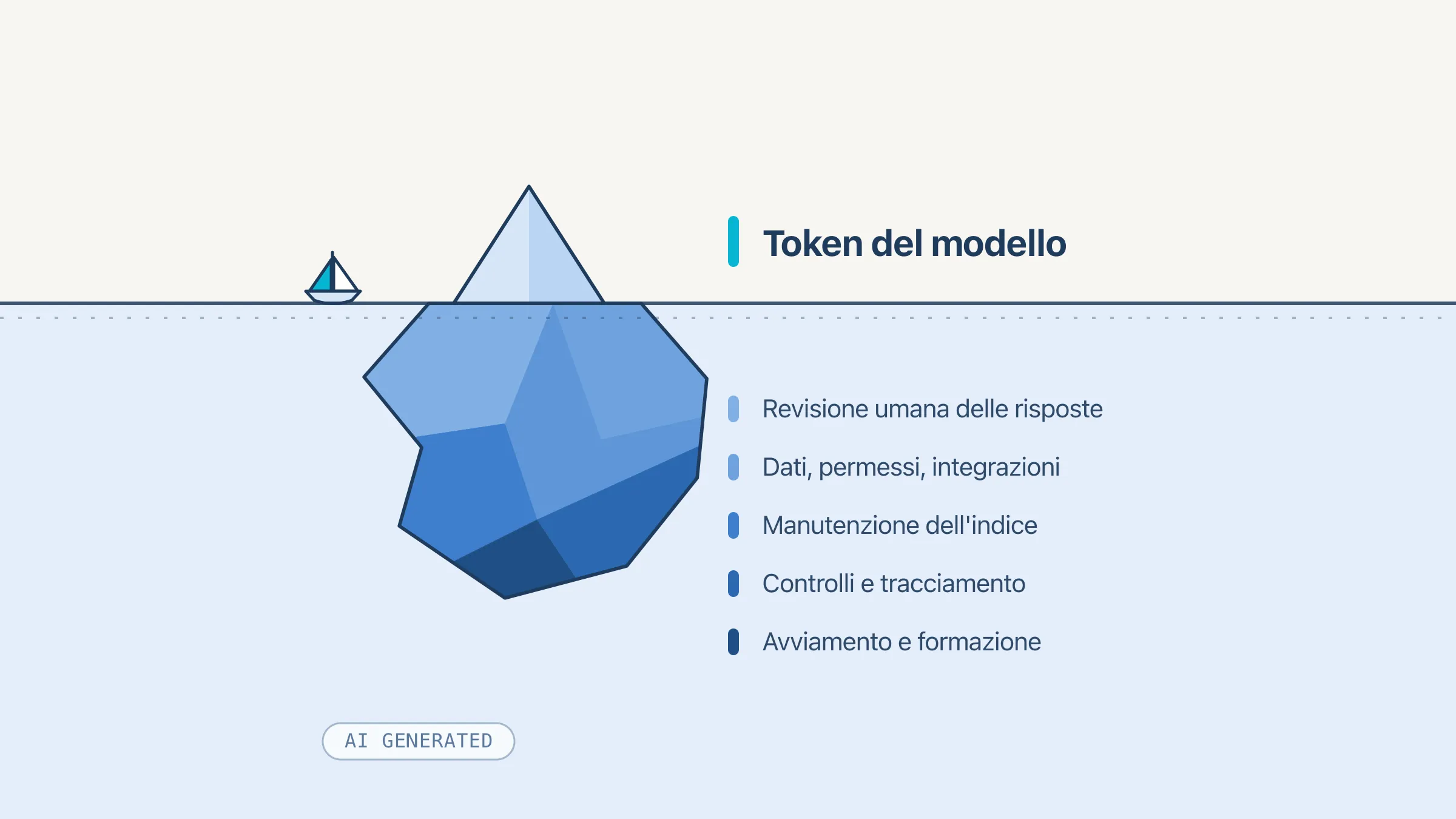
I have watched this play out for a couple of years now in the companies we work with. Someone in the engineering office picks an AI, uploads twenty or so manuals and builds an assistant that answers the maintenance team’s questions. It works, and often better than anyone expected.
Then comes the real question: what does it cost to open the system up to everyone in the company?
The curious thing is that this question has a precise answer, and you can get to it in ten minutes with a calculator and a public price list. Stay with me and we will work it out together, step by step. The problem is that the precise answer covers the smallest cost item of them all, and that is why so many projects clear the prototype stage and then stall six months later.
The case, with the numbers on the table
Let us take the example of an assistant built on technical documentation: machine manuals, diagrams, revisions and so on, the documents that maintenance and service work with every day. Say ten people use the system, six questions a day each, two hundred and twenty working days. That makes 13,200 questions a year.
Every answer moves roughly these tokens: 1,500 of system instructions, eight manual extracts of about 700 tokens each, 400 tokens between the question and the conversation history. That is 7,500 tokens going in. Coming out we allow 600 tokens, an answer ten lines long with references to the sources.
The figures I have used are typical reference values for a system of this kind: I chose them by taking the middle of the ranges you run into most often. Clearly, if your company has eighty technicians, or longer manuals, the calculations that follow are easy to redo.
The token bill
The price lists are public. Take Claude, as of September 2026: Haiku 4.5, the small tier, costs 1 dollar per million input tokens and 5 per million output; Sonnet 5 costs 2 and 10; Opus 5, the top tier, costs 5 and 25. With other providers the order of magnitude does not change. Model prices are quoted in dollars, so from here on I convert the totals into euro at the European Central Bank reference rate for September 2026, 1 euro to 1.16 dollars.
To answer on documents that are already indexed (yes, I am ignoring the indexing phase, which happens once but is not free) the middle tier is enough, so let us start from Sonnet 5: the quality of an answer over an archive depends far more on how the documents are split and retrieved than on the raw power of the model. With the numbers above, one question is 7,500 tokens in and 600 out: 0.021 dollars, that is 1.8 euro cents. Multiplied by 13,200 questions a year it comes to 239 euro. With Haiku 4.5 it would be 120, with Opus 5 598.
Twenty euro a month, for a service that answers ten people every day.
This is the only number in the whole project you can know in advance, because it is the only one that comes from a price list rather than from the way people behave.
What happens when you move to the documents you actually have
The prototype works on twenty manuals that are typically clean, quite possibly hand picked by whoever built it. Production works with whatever is there. Let us redo the same calculation, changing one assumption at a time.
Documents in production are longer and messier, so answering takes twenty extracts instead of eight. Input goes from 7,500 to 15,900 tokens: 431 euro a year, almost double.
For answers that quote a safety procedure we want an automatic check, a second call that verifies the answer against the sources before showing it. That doubles it: 861 euro.
Then the service stops being an assistant and becomes an agent: it searches, re-reads, compares two revisions of a manual, queries the ERP to find out which machine that customer actually has, retries when it comes up empty. Eight model calls to complete one task, with a context that keeps growing. 2,642 euro a year, eleven times the starting point.
And here the choice of model stops being a detail. Deciding which document to open and comparing two revisions is the work where the top tier pays for itself, while answering from an extract you have already found is not: the same agentic scenario on Opus 5 costs 6,606 euro a year. Between the starting case and this one, for the same service, the cost goes up about thirtyfold.
It is still only a few thousand euro. Keep that order of magnitude in mind, because the next section needs it for comparison.
The number nobody measured
Same company, same telemetry, different question: how many of those 13,200 answers need a person to step in? Checking a doubtful citation, correcting a procedure, handling the case the system did not “get”, answering the technician who was given the wrong instruction.
Say twelve minutes per intervention and thirty five euro an hour of loaded cost.
If interventions run at 5% of answers: 132 hours a year, 4,620 euro. Three weeks of work.
If they run at 15%: 396 hours, 13,860 euro. Two and a half months of one person, which was in nobody’s initial calculation, and in no budget either.
Ten percentage points on a number nobody measured are worth 9,000 euro a year, more than the model costs in any scenario in this article. The prototype could not reveal any of this: the test questions were written by the person who built it, and that same person judged the answers to be good.
That is what “the PoC worked” actually means: it worked on a sample chosen by someone with an interest in showing that it worked perfectly, and that getting there had been easy. To be clear, this is not dishonesty, it is the nature of prototypes, often built after a rather hasty design phase.
The items no price list contains
What stays out of the calculation is the expensive part, and it appears in no price list, because it does not depend on the vendor but on how your company is put together.
Data and the integrations around it are routinely underestimated, and in our daily work building industrial software and collecting data from machines they are almost always the heaviest item. How many manual revisions come out in a year, and therefore how often the index has to be rebuilt. How many different formats there really are, counting the scanned PDFs nobody admits to having. Who is allowed to see what, and how you enforce it once semantic search runs across the whole archive. How many systems have to be queried to produce a useful answer, and what happens when one of them is down.
Then the controls, which by definition do not exist in a prototype: tracking what was asked and what was answered, noticing when quality degrades, knowing which version of the manual an answer given three months ago was based on.
I am not going to attach figures to these, because they would be invented. What I can give you are the questions that produce those figures, and that is the work to do before widening the service, not after.
The assistant also measures your documentation
Let us go back for a moment to the twenty extracts that doubled the bill earlier. That number says nothing about the model, but it says a great deal about the documents. If answering a single question takes twenty pieces instead of eight, the same information is probably scattered across many different places.
The metrics you switch on to keep spending under control are also the first objective measurement your company has ever had of its own technical documentation, for the simple reason that until now almost nobody had read all of it.
Questions that find no source at all are the holes: things technicians have always asked a colleague about, because they are written down nowhere. Answers that change depending on how you phrase the question come from several revisions living side by side. Sections that never get retrieved are pages nobody needs, and that you pay for anyway in indexing and maintenance.
This is not meant as a lecture, documentation ages in every company, ours included. The point is that now you can show it with numbers, and the conclusion is often not “we need a more powerful model” but “those twelve procedures need rewriting”. That is a cost of the project too, but it is a cost that was already there and that nobody could see.
Falling prices will not save us
There is a standard objection to all of this: “models keep getting cheaper anyway”. True, and documented. Stanford’s AI Index measured that querying a model performing at GPT-3.5 level on the MMLU benchmark went from 20 dollars per million tokens in November 2022 to 0.07 dollars in October 2024. Two hundred and eighty times cheaper in eighteen months.
The point is that in the calculations above we never touched the unit price. What changed were the context, the number of calls and the people. The cost per token can keep collapsing: if meanwhile the context triples and the agent makes eight calls instead of one, your spending goes up all the same. And the part denominated in euro, the review hours, does not fall at all.
What happens to everyone else
It is worth looking at the public numbers on how these projects go, because they keep telling the same story.
Gartner predicted in July 2024 that at least 30% of generative AI projects would be abandoned after the prototype by the end of 2025. Looking back, its figure rose above 50%, with four recurring causes: poor data quality, inadequate risk controls, escalating costs, unclear business value. None of the four is “the model was not good enough”. They are the same items we listed above, the ones a prototype does not measure.
The GenAI Divide, from MIT NANDA, adds a figure that concerns us directly: in their sample, initiatives built with an external partner reached production about 67% of the time, against 33% for those built in house. The authors attach a warning that deserves repeating, given how well that figure would suit us: the difference may reflect the organisational capabilities of the companies that choose a partner rather than the approach itself, and correlation does not prove causation. The sample is 52 interviews, 153 survey responses and an analysis of more than 300 public initiatives.
In the Italian market, the Politecnico di Milano observatory reports that in 2025, 71% of large companies had started at least one AI project, against 8% of small and medium sized ones. Smaller companies have an advantage the large ones have lost: they have not made the mistakes yet, and they can start out measuring instead of finding out.
What we measure from day one
When we set up a pilot, the part that takes the most discussion is not the model. It is deciding what to count, and starting the counter before you begin rather than after the first invoice surprises somebody.
The minimum list is short: input and output tokens per answer, number of model calls per completed task, how many answers end up in human review and how long the review takes, how many questions find no source, which version of the document the answer came from. Plus one thing that is not telemetry and weighs as much as all the rest: who in the company pays for that service and who collects the benefit.
With those numbers, after six weeks of a real pilot, the cost per valid answer stops being an estimate and becomes a measurement, and the jump from ten users to a hundred gets decided on concrete figures instead of on a demo that went well.
Without those numbers, the prototype told you one thing only, that the model works. And by now I would say we all know that.
If you have a prototype sitting on your desk and you have to decide whether to widen it, write to us at rgb@fancypixel.it: we are happy to redo the calculations in this article with your volumes.